Speech Therapy for 2 Year Olds, 3 Year Olds and 4 Year Olds: What Changes
At two it is mostly you. At three the child starts doing the work. At four it begins to look like what people picture when they hear speech therapy. Here is why.
Speech therapy for 2 year olds, 3 year olds and 4 year olds are three different jobs, and parents are often surprised by how little the first one resembles what they pictured. At two, most of the work is aimed at you. At three, the child begins doing more of it directly. By four, it starts to look like what people imagine when they hear the words speech therapy.
If you are still working out whether to make the call at all, our article on speech milestones by age covers the when. This one covers the what, once you have decided. The speech and language therapy page covers the service itself.
Why does speech therapy for 2 year olds look nothing like therapy?
A two year old cannot be reasoned with about why they are here, will not sit at a table, and has an attention span measured in seconds. None of that is a problem, because the therapy at this age is not really being delivered to them.
The work is built around changing what happens in the rest of the week. Your therapist will show you something specific to use at home. Not general encouragement, but a particular technique: pausing longer than feels natural, holding an object up near your face, saying a word twice and waiting, offering a choice of two things instead of asking a question.
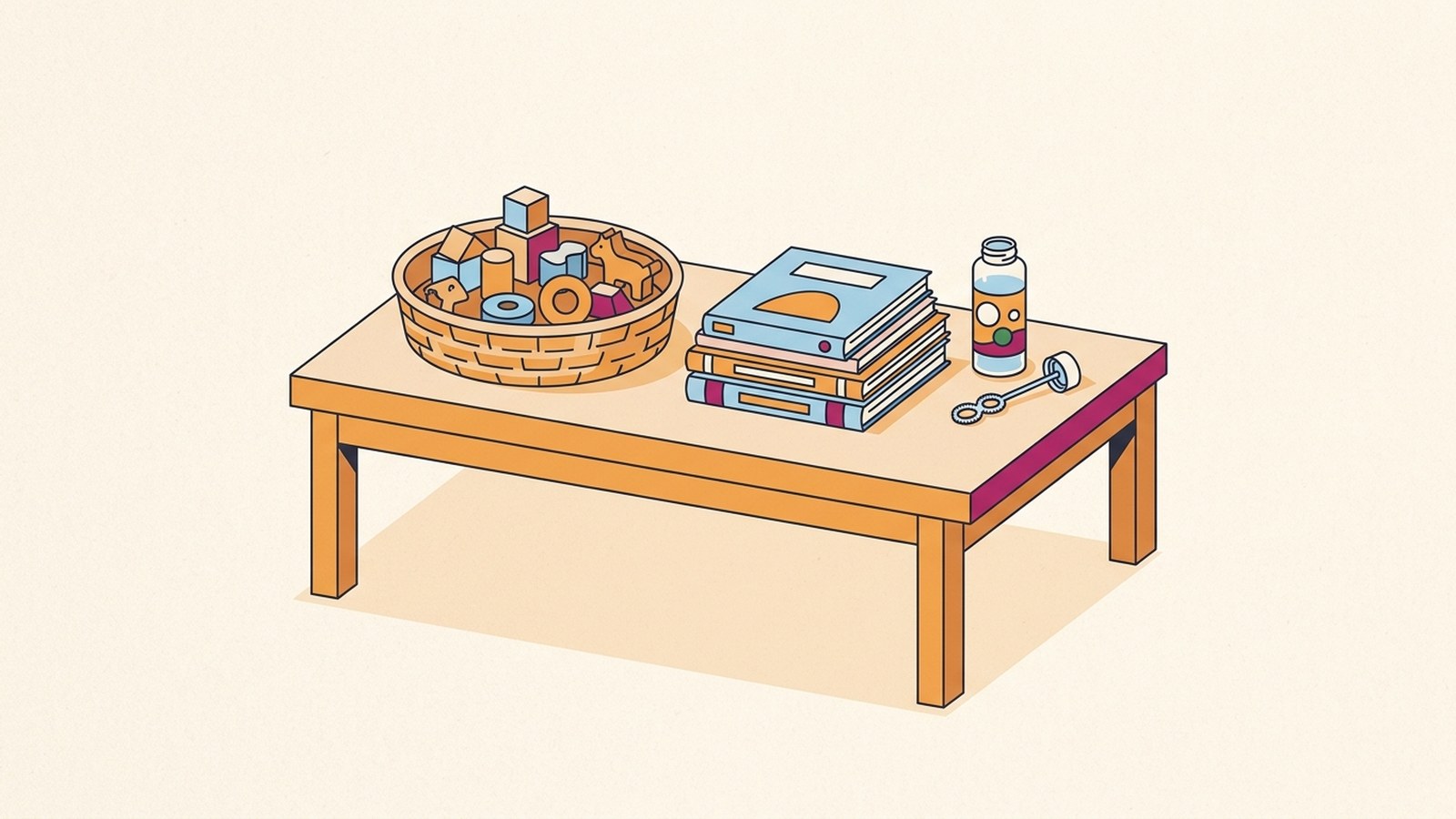
Sessions happen on the floor, with bubbles, snacks, a ball, a book, whatever the child will engage with for ninety seconds at a time. A therapist who looks like they are just playing is usually doing something quite deliberate inside the play.
You should expect to leave with two or three things to do during ordinary routines, and to be asked how last week’s went. That question is not a check on whether you did your homework. It is the main measurement instrument at this age.
What progress looks like: more attempts, more sounds, more gestures, more turn taking. Words often come later than any of those, and the things that come first are the reliable early signs.
At two: what the hour is actually buying
It is worth naming what a parent is paying for at this age, because it is not obvious from the outside.
You are not buying an hour of someone working on your child. You are buying a diagnosis of what is actually going on, a small number of techniques chosen specifically for that, and someone checking each week how they are going and adjusting them. The techniques look simple written down and they are surprisingly hard to do well without feedback, which is the part that cannot be got from an article or a video.
The other thing you are buying is a check on whether it is working. A therapist seeing your child every week notices changes you cannot, because you are with them constantly and change at this age is gradual. Having someone independently tracking direction is worth a good deal on its own, particularly for families who have been told to wait and see by several people already.
At three: the child starts doing the work
Three is the turning point, and it is more of a jump than the twelve months between two and three suggests.
A three year old can follow a simple instruction, take a turn, tolerate a short structured activity, and understand that something is being asked of them. That makes direct work possible for the first time, and sessions start to contain identifiable tasks rather than being entirely play.
They still move constantly and the session still follows the child, but a therapist can now set up an activity with a goal inside it and expect several attempts at the target rather than one accidental one. Repetition becomes possible, which matters enormously for sound work.
Parent coaching does not disappear at this age, it changes shape. Instead of teaching you a strategy for the whole week, your therapist is more likely to be showing you what they just did and asking you to run the same activity at home.
Three is also the age at which the public system hands over, so families often arrive here for the first time at exactly this point, having aged out of early intervention on a birthday.
What progress looks like: longer sentences, more intelligible speech, better answering of questions, and a child who is starting to repair a misunderstanding rather than giving up on it.
At four: it starts to look like therapy
By four, most children can sit for a structured activity, attend for a reasonable stretch, and understand that they are working on something. Sessions get more recognizably like teaching.
Sound work becomes properly systematic: hearing a target, watching how it is made, producing it in isolation, then syllables, words, phrases, and eventually ordinary conversation. Language work moves toward complex sentences, telling a story in order, understanding the sort of questions a classroom asks, and using language with other children rather than only with adults.
Four is also the age when the social cost starts to show. Children notice being hard to understand, and they notice each other noticing. A child who has begun avoiding speaking in group settings is dealing with something beyond the mechanics, and a good therapist will treat that as part of the work rather than a side effect of it.
What progress looks like: carryover. A sound produced correctly in the clinic is a start. The same sound produced at the dinner table without anyone prompting is the actual goal, and the gap between those two is where most of the time at this age goes.
What stays the same at every age
Three things do not change.
You are the most important variable. A child in weekly therapy spends under an hour with a clinician and the rest of the week with you. No amount of clinical skill overcomes that ratio at any age.
Play is the method, not the reward. At every age up to school, the thing that looks like play is the therapy. It is not a warm up before the real work starts.
Nothing is done without knowing what is being treated. Two children who sound similar can need entirely different plans, which is why an evaluation comes before therapy rather than after a few sessions of seeing how it goes.
What changes about the goals, not just the sessions
The shape of a goal shifts with age as much as the shape of a session does, and it is worth knowing what a good one looks like at each stage.
At two, goals are usually about communication acts rather than words. Requesting something. Protesting in a way that is not a meltdown. Getting an adult’s attention deliberately. Those sound modest and they are the foundation everything else is built on, because a child who has worked out that communication gets them things has a reason to keep trying.
At three, goals start naming structures: two word combinations, particular question forms, a set of sounds. There is enough language present to shape it, and enough cooperation to practice.
At four, goals begin to include the setting. Not just producing a sound, but producing it at preschool. Not just telling a story, but telling one a listener can follow. This is the point at which carryover becomes the difficulty rather than acquisition, and it is why the last stretch of therapy often takes longer than the first.
A goal you cannot picture happening in your kitchen is usually written badly. Ask for it to be rewritten.
What to expect in the first month
Slower than you want, and that is normal.
Early sessions are partly building a relationship, because a child who does not want to be there produces very little of anything. It is common for the first two or three sessions to look like not much happening, and for that to be exactly what should be happening.
Progress in the first month is usually visible in willingness rather than in output. More attempts, less frustration, more looking at the person they are talking to. Words and sounds follow, and they follow at very different speeds depending on the child and on what is being worked on.
If you are unsure whether what you are seeing is progress, ask your therapist to tell you what they are measuring and what the next milestone is. If you cannot repeat it back in a sentence, ask again until you can.
One more thing worth saying to parents of two year olds specifically. The most common regret we hear is not from families who started therapy and did not need it. It is from families who waited a year because the difficulty seemed small, and who then spent that year quietly worrying about it. An evaluation gets you an answer. Waiting a year gets you a year of the same question.
If you are somewhere in the two to four range and wondering whether any of this applies, tell us what you are hearing and we will tell you what an evaluation would involve.
Common questions
Will my two year old sit still for a session?
No, and a session built around expecting them to is badly designed. Two year olds move constantly, dip in and out, and lose interest without warning. A good session follows that rather than fighting it, which is why so much of it happens on the floor and why so much of it is aimed at you.
What will I do between sessions?
A small number of specific things during ordinary routines, and you will be asked how last week's went. Your therapist should tell you what each one is for and what a good week looks like.
How often will we come?
It depends far more on what is being worked on than on age. Motor based work generally needs short frequent sessions, while language work often does well with more time between sessions for things to be used at home. Ask what the recommendation is based on rather than accepting a default.
My child talks fine at home but not at preschool. Is that still speech therapy?
It might be, and it might be something else entirely. A child who is fluent with familiar people and silent with unfamiliar ones is showing a different pattern from a child who struggles everywhere. It is worth mentioning specifically at an evaluation, because it changes what is being looked at.
About this article. Written and reviewed by the clinical team at Joy Therapy and Learning Center, a pediatric therapy practice in Cumming, Georgia.
This article is general information and is not a diagnosis or medical advice about your child. If something here sounds familiar, speak to your pediatrician or ask us for an evaluation.