W Sitting in Children: What It Is and When It Actually Matters
Most young children W sit at some point, and the advice parents hear about it varies a lot. Here is what the position is, what the research says, and the situations where it is worth asking about.
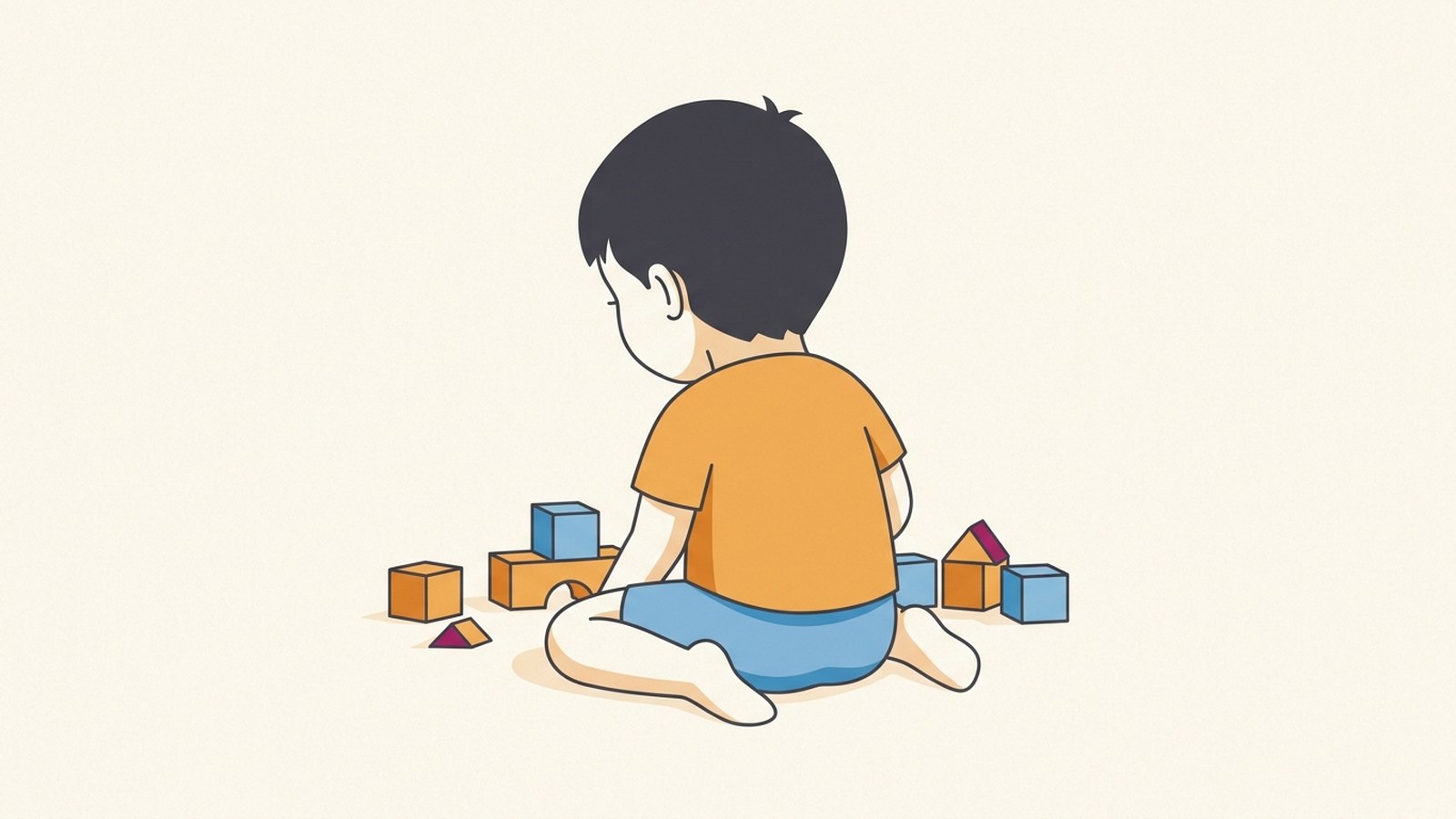
W sitting is when a child sits on the floor with their bottom between their feet, knees bent forward and lower legs turned out to the sides, so their legs make a W shape. It is very common in young children, and it worries a lot of parents. For most children it is not a concern on its own. When it is worth attention, the reason usually has more to do with why a child chooses the position than with the position itself.
Here is what the position is, what the research says, and when our pediatric physical therapy team would want to take a look.
What the position actually is
W sitting is a consequence of anatomy rather than a habit a child picks up.
Young children are commonly born with a degree of inward twist in the thighbone, known as internal femoral torsion. That twist makes the W position comfortable and stable, and it is why so many two and three year olds fall into it without thinking. The International Hip Dysplasia Institute describes it as a normal variation and notes that “during further growth, the bone twist goes away naturally in 99% of children without intervention”.
It is also a very stable position. The legs form a wide base, which frees a child from having to work at staying upright while their hands do something else. That matters later in this article.
W sitting in infants is uncommon, because it requires a child to be sitting independently and to have the hip mobility to fold into it. Most parents first notice it somewhere between two and four.
Why the advice you hear varies
Parents hear very different things about W sitting depending on who they ask. Some sources recommend discouraging it, with concerns about hip mobility, core strength and balance. Others describe it as a normal stage that most children grow out of.
Part of the reason is that there is not much research on the question. A lot of the advice families hear comes from clinical experience rather than from published studies, which is why it can sound confident in either direction. The most useful approach is usually to look at the individual child rather than at the position alone.
What the evidence shows
The best current summary is a systematic review published in 2024 in Acta Ortopedica Brasileira, which pulled together the seven studies that exist on the subject.
Its findings were reassuring. The authors found no correlation between W sitting and developmental dysplasia of the hip, no difference in muscle activation across sitting positions, and no scientific evidence supporting advice against the position. They also noted that the position tends to resolve as children develop.
The strongest single study in that review came out of a children’s hospital orthopedic program, which surveyed the families of children attending for hip imaging. Roughly 46 percent reported that their child W sits or used to. Those children were not more likely to have hip dysplasia.
The International Hip Dysplasia Institute adds a point from the anatomy side that is easy to miss: in its view, the position is a result of the natural twist in the thighbone rather than a cause of it.
The review’s authors are clear about the limits. Seven studies is a small body of research, and they call for longer term studies that do not yet exist. That is a good reason to look at each child individually rather than to treat the position as either harmful or harmless across the board.
So why do therapists still flag W sitting?
Because in some children it is a useful clue, and the clue is not about hips.
Remember that the W is an unusually stable base. A child who has to work hard to hold themselves upright will gravitate toward the position that costs them the least, and will stay there. So when a therapist sees a child who W sits constantly, the question worth asking is not what the position is doing to them. It is what the position is doing for them.
That is why the position turns up in conversations about low muscle tone, about children whose balance is still catching up, and about children who tire quickly in sitting. It is also why it comes up in discussions of autistic children, many of whom have lower tone or differences in how they organize movement. The position is not a sign of any condition, and reading it as one is a mistake in both directions.
Put simply: in most children W sitting is not the problem itself. Occasionally it is a visible sign of something else, and that something else is what deserves the attention.
When it is genuinely worth asking about
There is a short list, and none of it is the sitting on its own.
- It is the only position your child ever uses, and they resist or cannot manage cross-legged, side sitting or long sitting.
- They cannot move in and out of it easily, or they use their hands to get their legs into place.
- It is asymmetrical, with the same leg turned out every time.
- There is pain, limping, or in-toeing that is not settling as they grow.
- Motor milestones are behind, or a child tires far faster than peers during floor play.
- There is a known hip or neuromuscular condition. Children already diagnosed with a hip problem are a separate case, and their orthopedic team’s guidance takes precedence over anything here.
Any one of those is a reasonable reason to ask for an evaluation. W sitting by itself, in a child who is moving well and meeting milestones, is not.
What a physical therapist would actually look at
If a family does come in with this as their reason, very little of the session is spent on the sitting itself.
A therapist will watch how your child gets to the floor and back up, whether they can shift weight from side to side, and what happens when they reach across their body for something. They will look at hip range in both directions and compare the two sides. They will check how long your child can hold an upright position before they start to prop, lean or slump, because endurance is often the thing a parent has noticed without having words for it.
Most of that happens through play, and most children have no idea they are being assessed.
The outcome is frequently reassurance. A child who moves in and out of positions freely, has symmetrical range and keeps up with peers is a child who happens to sit in a W, and we will say so rather than finding something to treat. When that is the answer, it is worth the appointment to have it.
What is reasonable at home
Two things, and neither of them is constant correction.
Offer variety rather than corrections. Sitting on a low stool, against a wall, on a cushion, or at a small table all invite different positions without anyone having to be told off. Children who move between positions during play are getting what they need.
Build the underlying strength through play rather than through instruction. Crawling, climbing, carrying things, kneeling at a low surface and moving between the floor and standing all do more for trunk and hip strength than any amount of reminding.
Play that asks a child to shift their weight helps too: reaching for toys placed off to one side, playing in tall kneeling at the couch, or squatting to pick something up and standing again. These build the same strength without turning sitting into a rule, and most children will happily do them for much longer than they would tolerate a reminder.
If the reminders have become a daily argument, it is fine to ease off and focus on offering variety instead. Floor play should stay enjoyable for both of you.
The honest summary
For a child who is developing typically, W sitting is usually a comfortable position that fades on its own, and the research so far has not linked it to hip problems.
For a child who uses it because nothing else is stable, the position is a small window into something worth understanding. That is a real reason to ask, and it is a different reason than the one usually given. If that description sounds like your child, tell us what you are seeing and we will tell you honestly whether they need to be seen.
Common questions
Should I stop my child from W sitting?
For most children who are moving well and meeting milestones, the position on its own is not usually a cause for concern. Offering variety in how a child sits is a reasonable middle ground, and it keeps floor play from turning into a source of conflict. If you are unsure, ask your pediatrician or a physical therapist to take a look.
Does W sitting cause hip dysplasia?
Published research has not shown that it does. A 2024 systematic review found no link between W sitting and developmental dysplasia of the hip, although the authors noted that only a small number of studies exist. Children who already have a hip condition are a separate case and should follow their orthopedic team's advice.
At what age does W sitting usually stop?
It is most common between about two and six, and it typically fades as the natural twist in the thighbone unwinds with growth. The International Hip Dysplasia Institute reports that this resolves without intervention in the large majority of children.
My child only ever sits this way. Is that different?
It can be. A child who uses the position exclusively, cannot move in and out of other positions, or always turns the same leg out is showing something worth a closer look. In that situation it is the pattern around the sitting, not the sitting itself, that is the reason to ask.
About this article. Written and reviewed by the clinical team at Joy Therapy and Learning Center, a pediatric therapy practice in Cumming, Georgia.
This article is general information and is not a diagnosis or medical advice about your child. If something here sounds familiar, speak to your pediatrician or ask us for an evaluation.